# set tw: 72
Developer’s overview
A bird’s eye view
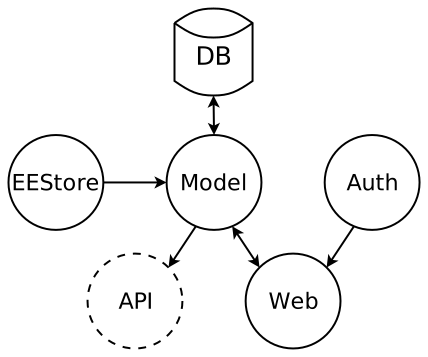
Figure 1: Bird’s eye view
Legend
Arrow with single arrow-head: read only, points towards reader Arrow with two arrow-heads: read-write
The DB is a PostGreSQL database that stores all state: questions, answers, templates, plans, FSAs and users.
The Model is an ORM that wraps the tables in the DB and holds the business logic.
Web is the web-interface generated from the Model where template designers create and edit templates and planners create and edit plans based on a preexisting template.
API is currently very rudimentary and is only a read-only view of most of the data in Model. Services who wishes to import data from EasyDMP should look here.
EEStore is an external, separate, micro-service that wraps, combines, simplifies and normalizes the data of several external services, like Re3Data and Cristin. The Model fetches data from the EEStore in order to generate drop downs and multiselect lists.
Auth is an OAuth2-client. Several OAuth2 IdP’s can be in use simultaneously.
Workflow
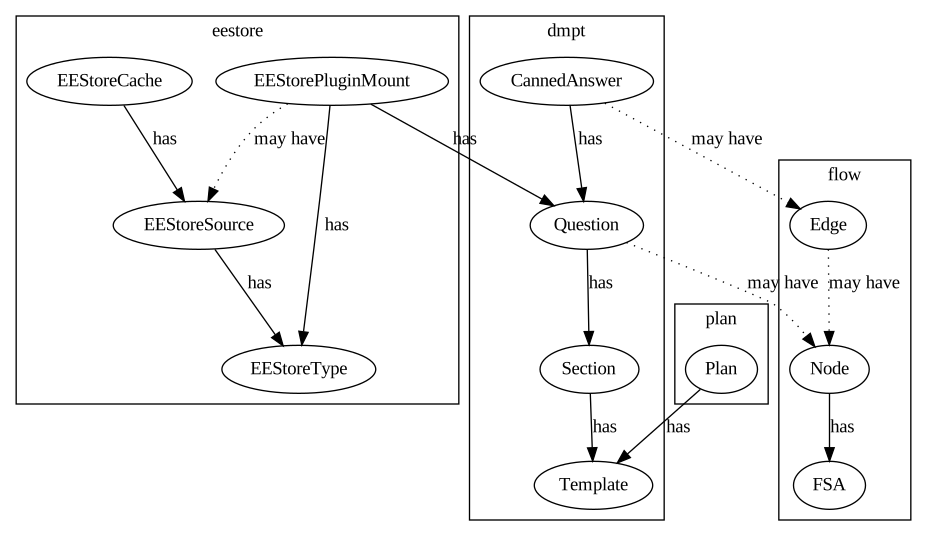
Figure 2: Inside the model
Templates
A template designer creates a plan template in the web interface. A template consists of some metadata and one or more sections. Each section consist of one or more questions, and each question has a type, a position, and is optionally part of an Finite State Automaton (FSA).
The sections can be reordered within a template, and the questions can be reordered within each section. The actual order of questions is also affected by any FSAs that questions are connected to.
The currently supported types are:
- Boolean
- Positive integer
- Text field
- Daterange
- Choice (choose one of a short list of predefined choices)
- Multi choice (choose one or more of a short list of predefined choices)
- Single url + name/description
- Multiple pairs of urls with name/description
- External choice (choose one of a long list fetched from the EEStore)
- External multi choice (choose one or more of a long list fetched from the EEStore)
The “Boolean” and “Choice”-types can branch, that is: which question is the next may depend on a specific answer. Such questions are part of an FSA, and their answers gives the keys to lookup the correct edge between two nodes. If there is no FSA, the next question is decided by position, higher position is asked later.
Plans
When planners create a plan, they answer each question in order, and the question-id and actual answer is stored in the plan. Each question-type then has logic to pretty-print the value of their answers, the so-called “canned answer”. The “canned answers” are used to generate a text that is suitable for a paper-based application process, be it for funding or etther resources.
In order to output the generated the text, the answers in the plan are run through a flow, a serialized traversal of a directed acyclic graph (DAG). By running the flow through an FSA the answers are mapped to canned responses, building up to a text that appears to be hand written. This is then suitable for being attached, in paper form if need be, to a project proposal.
The questions are not all nodes in the same FSA, as that proved to make template design quite unwieldy. Instead, only questions that lead to a branch and the questions that take part in the branches are part of the same FSA. Also, an FSA might only connect two questions that are in the same section. The goal is to have a winding road with the occasional shortcut, not a tree.
For simplicity’s sake, each question has its own page with its own url, so it is very easy to revisit a specific question.
Todo
A template, a section and a specific FSA can all be copied to be reused in a different template, section or FSA. Templates are versioned, and the system handles multiple templates simultaneously. A specific plan is made from a specific versioned template, and each plan is also versioned.